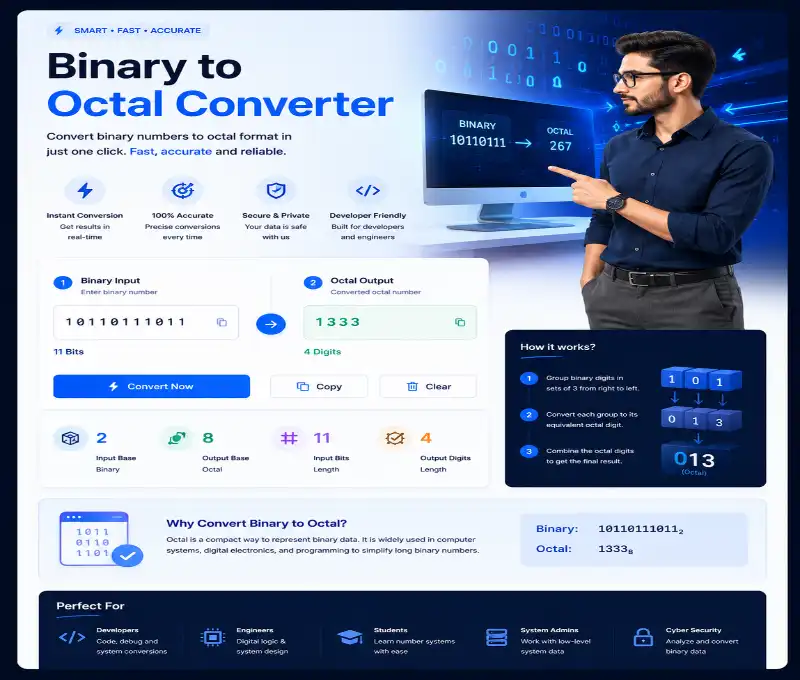
Free Binary To Octal Converter Tutorial - Complete Guide
Let's Master Binary to Octal Conversion!
If you've ever wondered how to transform those binary strings made of 0s and 1s into octal numbers (base-8), you're in the right place. This detailed How To Convert Binary To Octal tutorial covers every feature of the Binary to Octal Converter so you can convert binary to octal confidently and quickly.
The binary to octal converter is a powerful yet simple tool that groups every 3 bits of binary into a single octal digit. This makes it incredibly efficient for converting between these two number systems. Whether you're a programmer, student, or just curious about how computers work, this tool makes the process painless.
🔄
Reverse Conversion: Need to go from octal back to binary? Our
octal to binary converter handles the opposite direction and helps you understand how these number systems connect.
How Binary to Octal Conversion Works
Before we dive into the tool itself, let's quickly understand how to convert binary to octal. Since octal is base-8 and each octal digit represents exactly 3 binary bits (because 2³ = 8), the conversion is straightforward. Each group of 3 bits maps to a single octal digit from 0 to 7.
Here's a simple example: binary 001 010 011 breaks into three groups of 3 bits. Group 001 becomes 1, 010 becomes 2, and 011 becomes 3. So the final octal result is 123, which equals 83 in decimal!
🧮
More Conversions: To see how decimal relates to binary, check out our
binary to decimal converter which explains another important number system used in everyday programming.
Input Options Explained
1 Enter Your Binary Data
The input area accepts binary in either format space-separated groups like 001 010 011 or continuous strings like 001010011. The tool handles both automatically. What matters is that your binary length is divisible by 3 (or can be padded to become so).
One really useful feature is automatic padding. If your binary isn't already in complete 3-bit groups, the tool can add leading or trailing zeros to make it work. You'll see options to "Pad Left" (add zeros at the start), "Pad Right" (add zeros at the end), or "No Pad" (for exact 3-bit groups only).
🔣
Hex Alternative: To explore another popular base conversion, see our
binary to hex converter which handles base-16 conversion used extensively in programming.
Output Customization Features
2 Format Your Octal Output
Once you enter binary and convert, you can customize how the octal result looks. The prefix option lets you choose between plain octal (like 123) or the programming style with 0o prefix (like 0o123). This is particularly useful when writing code in languages like Python or C.
The results section shows multiple formats at once: plain octal, 0o-prefixed octal, decimal equivalent, hexadecimal, and even your binary displayed in both 3-bit and 8-bit groupings. Click any result card to copy it instantly the tool confirms with a "Copied!" message.
📊
Understanding Formats: For a complete set of binary conversion tools, visit our
binary tools collection which includes every converter you might need for different number systems.
The Triplet Breakdown Feature
3 See Each 3-bit Group Converted
The Triplet View tab provides a visual breakdown showing exactly how each group of 3 bits converts to its octal digit. You see the 3 bits, an arrow pointing down, the resulting octal digit, and its decimal value. This makes understanding the conversion process crystal clear.
This feature is especially helpful for students learning about number systems. You can literally watch each 3-bit group transform into its octal equivalent, building an intuitive understanding of how the conversion works.
🎓
Text Conversion: To understand how binary represents text characters, explore our
binary to text converter which explains ASCII encoding in detail.
Batch Processing for Multiple Values
4 Convert Several Binary Strings at Once
Need to convert many binary values to octal? The Batch tab handles this perfectly when you learn how to convert binary to octal. Enter multiple binary strings on separate lines, click "Convert All," and get results for all of them instantly. Invalid entries show error messages so you can identify and fix problems quickly.
This is incredibly useful when working with lists of binary data, processing log files, or converting multiple values from a dataset. You save time by converting everything in one go rather than one at a time.
📋
Decode More: For reversing binary to text, our
binary decoder handles multiple conversions and provides text output alongside other formats.
Developer Code Examples
5 Get Implementation Code
The Code tab provides ready-to-use examples in JavaScript, Python, PHP, Java, and C. Each snippet shows exactly how to implement binary to octal conversion in that programming language, including the padding logic needed for non-3-bit-multiple inputs.
These code snippets are perfect for developers who need to integrate this conversion into their applications. They include proper error handling and can be copied directly into your projects. You'll also learn how different languages handle the conversion process.
💻
Reverse Process: For understanding how to convert decimal numbers to binary, check out our
decimal to binary converter which explains the mathematical approach.
When You'll Use This Tool
Here's where binary to octal conversion comes in handy:
- Unix/Linux Permissions: File permission codes in Unix systems use octal (like 755, 644).
- Low-level Programming: Working with embedded systems or hardware interfaces.
- Computer Science Education: Learning about number systems and data representation.
- Digital Electronics: Working with devices that use octal addressing.
- Legacy Systems: Some older computer systems and mainframes use octal.
🛠️
Keep It Handy: Since this binary to octal converter is useful, save our
main converter page so you can access it whenever needed.
Frequently Asked Questions
How do I manually convert binary to octal using this tool?
Simply group your binary into sets of 3 bits starting from the right. Add leading zeros if needed. Then convert each 3-bit group to its octal digit (000=0, 001=1, 010=2, 011=3, 100=4, 101=5, 110=6, 111=7). That's it!
Why does binary need to be in groups of 3?
Because octal is base-8 and 2³=8. Each octal digit represents exactly 3 binary bits. This mathematical relationship makes the conversion clean and efficient with no loss of data.
What does "Pad Left" or "Pad Right" mean?
If your binary isn't already in complete 3-bit groups, you can add zeros. Pad Left adds zeros to the beginning (like 01 becomes 001), while Pad Right adds them to the end. Both give correct results it's just a matter of preference.
What's the 0o prefix used for?
In programming languages like Python, JavaScript, and C, you write octal numbers with 0o prefix (like 0o123) to distinguish them from decimal numbers. This is standard notation in many languages.
Can I convert multiple binary strings at once?
Absolutely! Use the Batch tab, enter one binary string per line, and click "Convert All." The tool processes all lines and shows results together, making it easy to handle multiple conversions.
Is the conversion accurate?
Yes, 100% accurate. The tool uses precise mathematical conversion following how to convert binary to octal mapping, ensuring reliable results every time.
Give It a Try! Open the converter, enter some binary numbers, and experiment with all the features. The more you use it, the more natural binary to octal conversion becomes!
That's your complete guide to the Binary to Octal Converter! From basic conversion to triplet breakdowns, batch processing, and developer code this tool has everything you need.